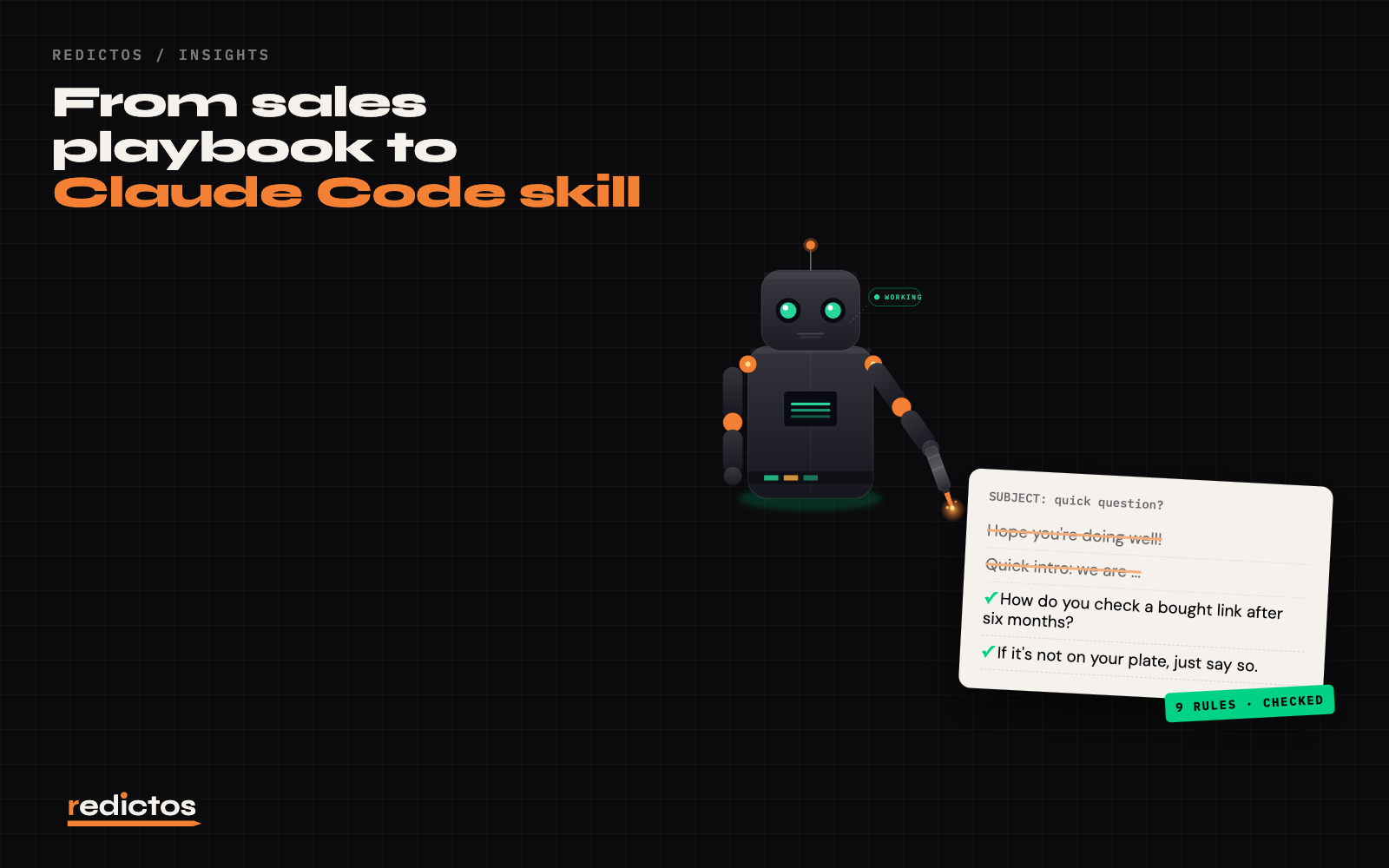
Six words that make sellers sound needy, and why knowing them is not enough
Every cold email writer has seen the list. "Just", "love", "honestly", the words that make a seller sound needy. Everyone nods. And the next draft written at 16:30 still opens with "hope you're doing well", because nobody opens the checklist at 16:30.
We translated the method of a sales trainer whose newsletter we have read for years into a skill for Claude Code. Since 25 September every cold email we write runs through that check before it enters a sending tool. This piece shows the structure, the one adjustment that made or broke it for us, and the five steps to do the same with the book or newsletter of your choice.
What a skill is, and what it is not
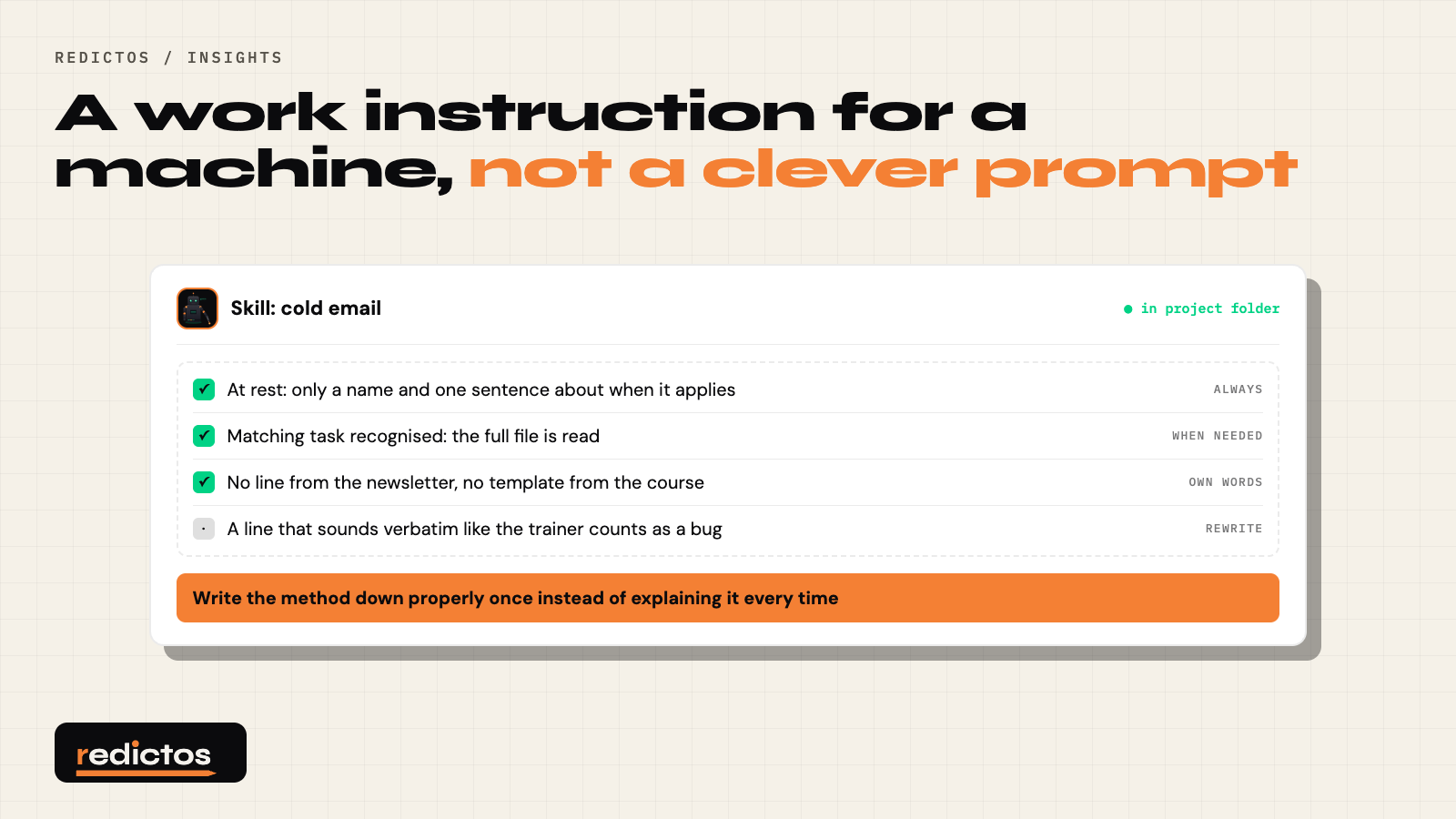
A skill is a work instruction for a machine, not a clever prompt. The difference is practical: a prompt is typed fresh each time and half of it is forgotten. A skill is a Markdown file in the project folder, and the agent reads it on its own when it recognises a matching task. At rest it costs almost nothing. The spine only carries a name and one sentence about when it applies. It is only read in full when needed.
That also explains why the format is spreading so fast among marketers right now. Whoever turns a book into a skill no longer has to explain the method. They have to write it down properly once.
What a skill is not: the author's text. Our skill contains no line from the newsletter and no template from the course. Ideas and methods are free, phrasings are not. If a line in the skill sounds verbatim like the trainer, it counts as a bug here and gets rewritten.
The structure of our cold email skill
The file has five parts. Each one answers a question the agent would otherwise have to guess.
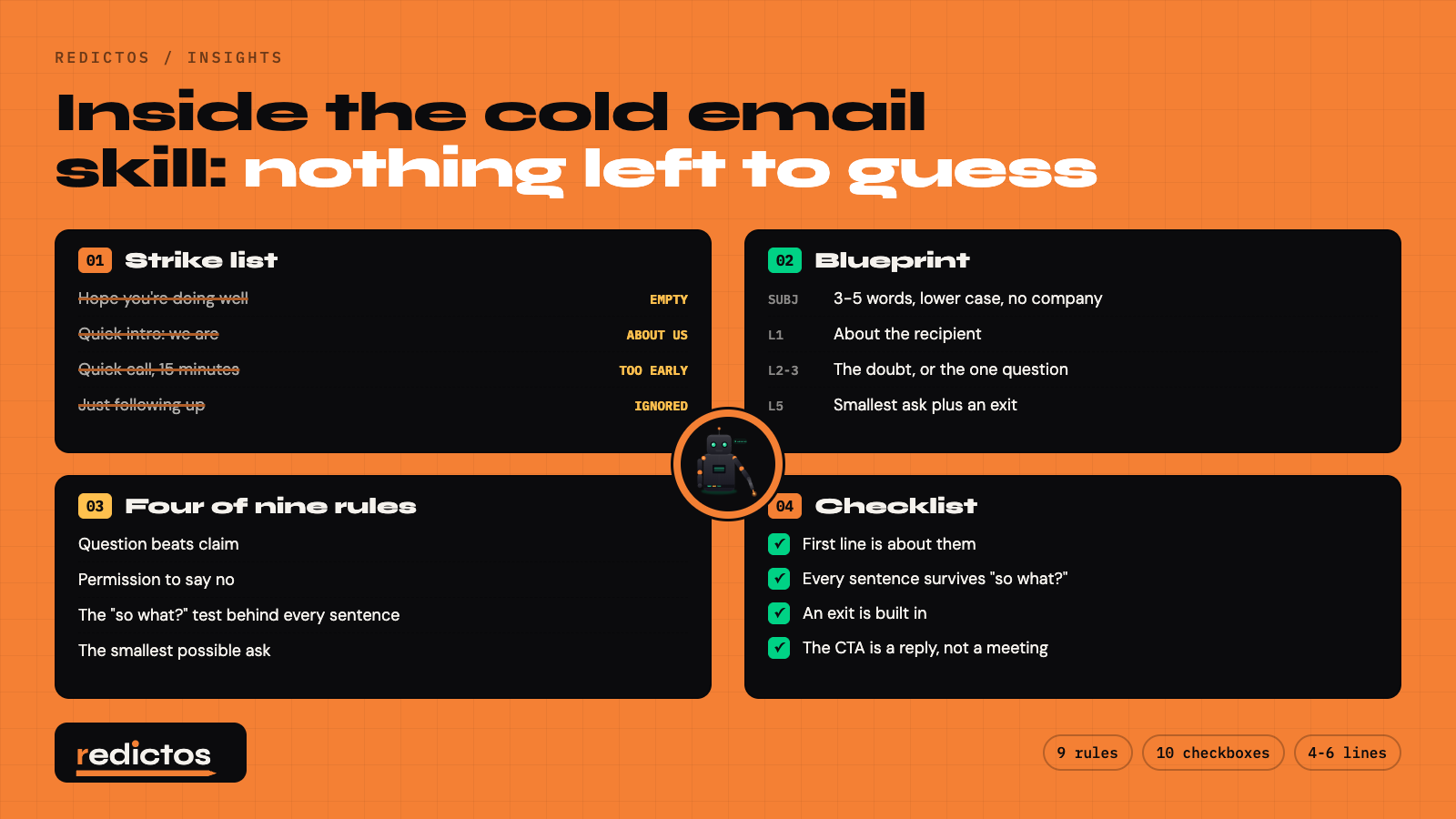
1. The one sentence. The method in one line the agent reads before every draft: the competition is not the other vendor, it is the recipient doing nothing. An email that argues against a competitor argues against the wrong opponent.
2. Nine rules, each with a before and after. Question beats claim. Their words, not ours. Permission to say no. So specific the email could go to nobody else. Show, don't tell. The "so what?" test behind every sentence. The smallest possible ask. Follow-ups carry something new. Stand one step lower. Every rule comes with a bad and a good example from our own business, not from the course. Example for rule one: "Our links rank more reliably" gets read and contradicted in the reader's head. "How do you measure whether a bought link still carries weight after six months?" gets read and thought about for a second.
3. The strike list. A table of phrases the agent removes without asking, and why. "Hope you're doing well" is an empty sentence in position one. "Quick intro: we are" is a first line about us. "Quick call, 15 minutes" is an expensive ask, too early. "Just following up" is a reminder that you were ignored. The list is written per language and maintained by hand, because an English spam word list finds nothing in a German or Spanish text and that silence then gets mistaken for approval.
4. The blueprint. Subject three to five words, lower case, no company name, no question mark. Line one about the recipient. Lines two to three the doubt, or the one question. Line four a proof point if one holds, otherwise cut it. Line five the smallest ask plus an exit. Four to six lines, readable in under fifteen seconds.
5. The checklist at the end. Ten boxes the agent works through before handing over and prints with the result. First line is about them. Every sentence survives "so what?". No adjective without an observable fact behind it. An exit is built in. The CTA is a reply, not a meeting.
The adjustment without which the skill would have hurt us
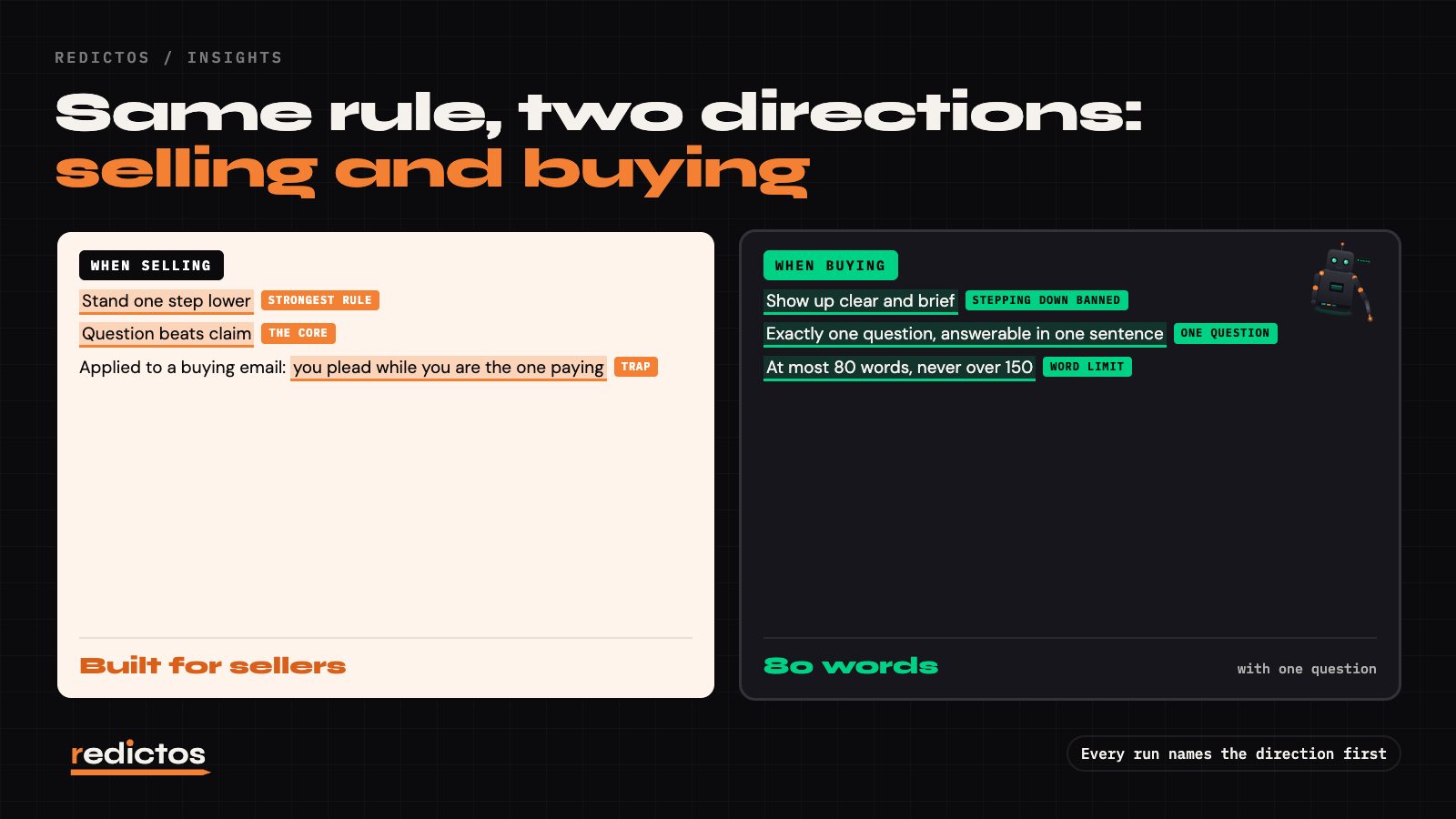
This is the part a book cannot know. The method is built for sellers. Half of our mail goes the other way: we buy placements from publishers. Apply seller rules to a buying email and you are pleading while you are the one paying.
So the skill has a second column. For every rule it states how it applies when selling and how when buying. "Stand one step lower" is the strongest rule when selling and explicitly banned when buying: as a buyer we show up clear and brief. "Question beats claim" is the core when selling and, when buying, exactly one question the publisher can answer in one sentence. Buying emails also get a word limit: at most 80 words with one question, never over 150.
Without that column the skill would have turned our buying emails into begging letters. With it, every run names the direction first and then reads the matching column. That is the one question to ask of every book you turn into a skill: which situation did the author write for, and which one are you in?
What the skill cannot do
It checks whether an email sounds like a seller. It does not check whether it sounds like a machine. A second skill runs afterwards for that, hunting filler and stock phrases. And it does not check whether the number in line four is true. For that we keep a context file of proof sentences, each with a source. A skill that produces copy without having read that file first has already made the mistake.
Three skills, three different mistakes. That is why we do not merge them into one.
From book to skill in five steps
- Pick a source whose rules you are already breaking. Not the book you like best, but the one whose rules are missing most often in your last ten emails. Take the ten emails and count.
- Write the method in one sentence, in your own words. If you cannot phrase it without the book, you have not understood the method yet. No quote, no template from the course.
- Turn every rule into a before-and-after pair from your business. The agent does not know the book's example better than yours, but yours knows your customers.
- Build the strike list and the direction column. Which phrases go without asking? And which situation did the author write for, which are you in? Where the two differ, the rule needs a second column.
- Attach a checklist and a learning appendix. The checklist prints with every result. The appendix asks three questions after every run: did a step fail? did the human correct something? did anything come up that a future run needs? The answers go into a file the skill reads first next time.
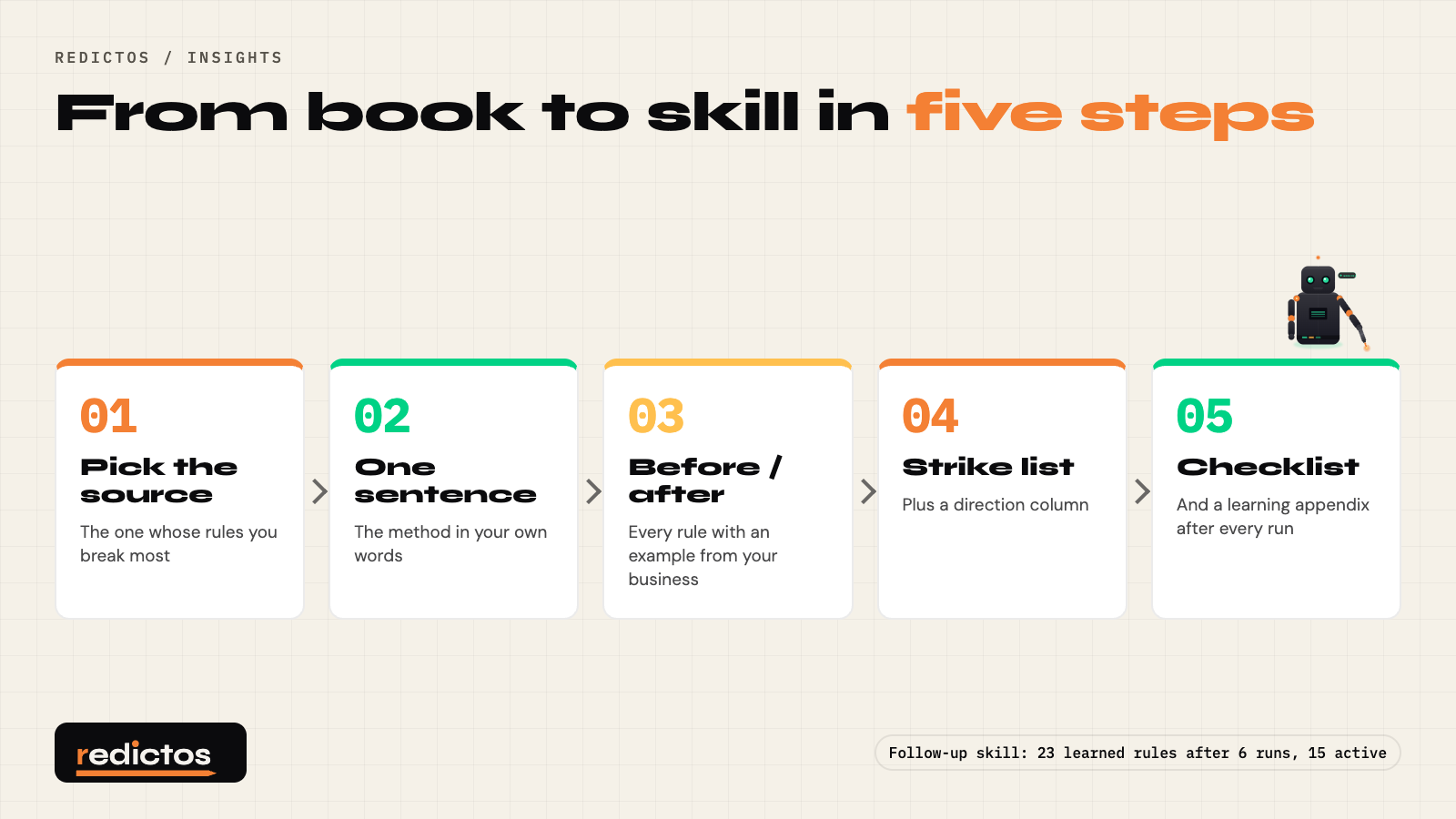
The last step is the one most people skip, and it is the only reason the skill is better after a month than on day one. Our follow-up skill had collected 23 such rules after six runs, 15 of them active. None of them was in the book.
What we have not measured yet: whether the checked emails get more replies than the unchecked ones. A campaign here needs at least 1,000 sends before we judge it, and the first wave with the skill has not reached that number. When it does, the result goes here, whichever way it points.